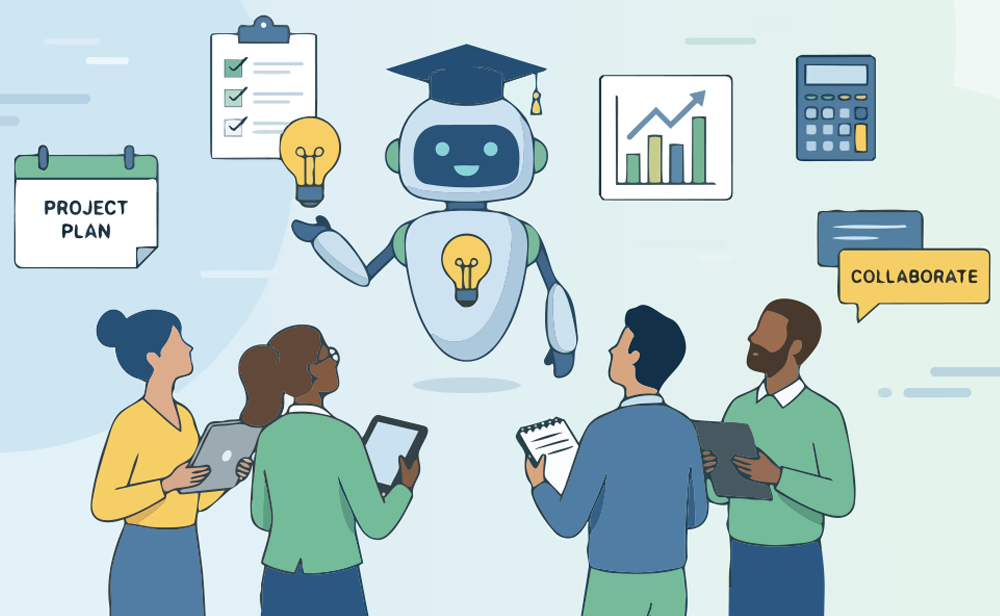
Will AI automate my profession?
Why people are still the most important part of Project and Portfolio Management
Introduction
AI is transforming how we work – but the best project outcomes still depend on human judgment, relationships, and accountability.
Every week brings a new headline about AI automating another profession. Project management is no exception. Tools promising to “run your projects with AI” are multiplying fast, and enterprise buyers are under pressure to adopt them.
But here’s what experienced project and portfolio management (PPM) professionals already know: the hardest parts of managing projects have never been about processing data. They’ve been about people.
This article explores why human judgment remains irreplaceable in PPM – and how the smartest organizations are thinking about the relationship between AI tools and the people who lead their portfolios.
The seductive promise of AI-driven project management
It’s easy to see why AI in project management sounds appealing. Late projects, blown budgets, and misaligned portfolios cost organizations billions every year. If a machine could predict risks, rebalance workloads, and flag dependencies automatically, why wouldn’t you use it?
The answer isn’t that you shouldn’t. It’s that AI solves a different problem than the one that causes most project failures.
Studies consistently show that projects fail not because of poor scheduling software, but because of:
- Misaligned stakeholder expectations
- Poor strategic prioritization
- Lack of executive sponsorship
- Inadequate change management
- Teams working to conflicting priorities
None of these are data problems. They are human problems. And they require human solutions.
What AI can – and cannot – do in PPM
Let’s be clear: AI has genuine and growing value in project and portfolio management. It can:
- Analyze large volumes of project data faster than any human
- Surface patterns and anomalies across a portfolio
- Generate status summaries and draft reports
- Model scenarios and run simulations
- Flag risks based on historical data
These are real productivity gains. A well-configured AI tool can save a PMO team hours of manual aggregation work every week.
But here is the critical distinction: AI can tell you what is happening. Only a human can decide what to do about it.
When the data shows that three strategic projects are competing for the same scarce resource, AI can surface that conflict. AI cannot negotiate with the VP who owns one of those projects. It cannot weigh the political consequences of deprioritizing a CEO-sponsored initiative. It cannot read the room in the steering committee meeting and know when to push and when to hold back.
That judgment is irreducibly human.
Five things only people can do in project management

1. Exercise judgment under uncertainty
Enterprise projects never unfold the way the plan says they will. Scope changes. Key people leave. External conditions shift. Strategic priorities evolve mid-delivery.
Human project managers and portfolio leaders don’t just react to these changes – they anticipate them, adapt to them, and navigate them using experience, intuition, and contextual awareness that no AI model currently possesses. They make judgment calls in conditions of genuine ambiguity, where the “right” answer cannot be derived from historical data.
AI optimizes for the world as it was. People navigate the world as it is.
2. Manage relationships and build trust
Project delivery is a contact sport. It depends on relationships – between the PMO and the business, between project sponsors and delivery teams, between the organization and its suppliers and partners.
Trust is the invisible infrastructure of every successful project. It is earned over time through transparency, reliability, and honest communication. It is maintained through difficult conversations, carefully handled. Trust is also destroyed by a single moment of misalignment or bad faith.
AI cannot build trust. Your people can.
Stakeholder management – arguably the single most important discipline in portfolio management – is fundamentally relational. The software that supports great project managers is software that gives them the clarity and insight to have better conversations, not software that tries to have those conversations for them.
3. Own accountability
When a major program fails, no board of directors calls the software. They call the portfolio director or the program sponsor. Fundamentally, they review decisions that were made by people.
Human accountability is not just a governance formality – it is the engine that drives serious decision-making. When a person knows they own an outcome, they bring a quality of attention and care to their decisions that no automated system can replicate.
Meaningful accountability requires meaningful human ownership. That means portfolio leaders need tools that give them clarity, visibility, and control – not tools that make decisions on their behalf and leave them unable to explain why.

4. Align projects to strategy
Portfolio management at its best is not about tracking projects. It is about making strategic choices: which investments to fund, which to pause, which to kill, and how to sequence delivery to maximize organizational value.
These are not analytical decisions alone. They involve understanding the organization’s risk appetite, its culture, its political landscape, and its medium-term strategic intent. They involve trade-offs between competing goods, not just competing data points.
A portfolio management tool can show you the numbers. It takes a senior leader – with experience, credibility, and strategic awareness – to make the call.

5. Lead change
Projects don’t just deliver outputs. They drive change in organizations – new systems, new ways of working, new structures, new capabilities. And change is always a human experience.
People resist change not because they are irrational, but because change is disruptive, uncertain, and often threatening to established identities and ways of working. Leading change requires empathy, communication, persistence, and genuine leadership.
No AI tool can lead your organization through a major transformation. Your people can – if they are supported with the right information and the right tools.
The right model: AI as co-pilot, not autopilot
The most effective approach to AI in project and portfolio management is one of augmentation, not replacement.
Think of it like aviation. Modern aircraft are packed with automation – autopilot systems, collision avoidance, automated landing assist. These systems make flying safer and more efficient. But no one is seriously arguing we should remove pilots from the cockpit. Automation handles routine tasks and surfaces critical information, but the pilot makes the judgment calls, responds to the unexpected, and is ultimately accountable for the flight.
The same logic applies to PPM. AI tools can handle data aggregation, reporting, scenario modeling, and pattern recognition. They free your project managers and portfolio leaders from administrative burden so they can focus on what only humans can do: lead, judge, build relationships, and own outcomes.
This is why forward-thinking PPM platforms are designed not to embed AI as a black box making decisions for you, but to integrate with best-of-breed AI tools and agents – giving your teams the flexibility to leverage AI capabilities where they genuinely add value, while keeping human judgment firmly in the loop.
What this means for how you choose PPM software
If you are evaluating project and portfolio management software, the question to ask is not “how much AI does it have?” The question is: “Does this tool make my best people more effective?”
Look for platforms that:
- Give portfolio leaders a clear, real-time view of the portfolio so they can make informed decisions
- Support the governance processes that create accountability and alignment
- Integrate with the AI and data tools your organization already uses, rather than locking you into proprietary automation
- Present information in ways that support human decision-making, not replace it
- Are flexible enough to reflect how your organization actually works
The goal is a system of record that your people trust – one that gives them the visibility to lead with confidence, the governance to stay aligned, and the flexibility to bring in the right AI capabilities as the technology matures.
Conclusion: The human edge
As AI tools become more capable, the temptation will grow to hand more and more of the project management process over to automation. Some of that will be genuinely valuable. But the fundamentals will not change.
Projects are delivered by people, for people, in organizations full of people. The politics, the relationships, the judgment calls, the accountability, the leadership – these will always be human domains.
The organizations that will get the most from AI are not the ones that use it to replace their project professionals. They are the ones that use it to make those professionals more powerful – freeing them from the administrative burden so they can focus their energy where it matters most.
That is the future of project and portfolio management. And it starts with remembering that your most important PPM tool has always been the people in the room.
If you’d like to learn how Bubble’s Project Portfolio Management software could further improve your process, please follow one of the links below or contact us.
E: hello@bubblegroup.com T: +44 (0)1223 852664
Deliver greater value from your projects and portfolios
Turbocharge productivity in your organization
About Bubble
Bubble® is a leading software company specialized in the development of Enterprise Project Management and Project Portfolio Management (PPM) solutions. Our cloud-based PPM software, Bubble PPM, helps organizations in Innovation, R&D, New Product Development, and other disciplines, to select the right projects, execute them reliably, and improve productivity.
Founded in 1999, the company is Headquartered in the UK, serving customers across the globe via our offices in Cambridge, London, and Melbourne.
About Bubble
Bubble® is a leading provider of Project and Portfolio Management software. Founded in 1999, the company serves clients globally via offices in London, Cambridge, and Melbourne.
Its cloud-based solutions help customers improve the planning, governance, and delivery of Innovation, New Product Development, Engineering, IT, and other initiatives.