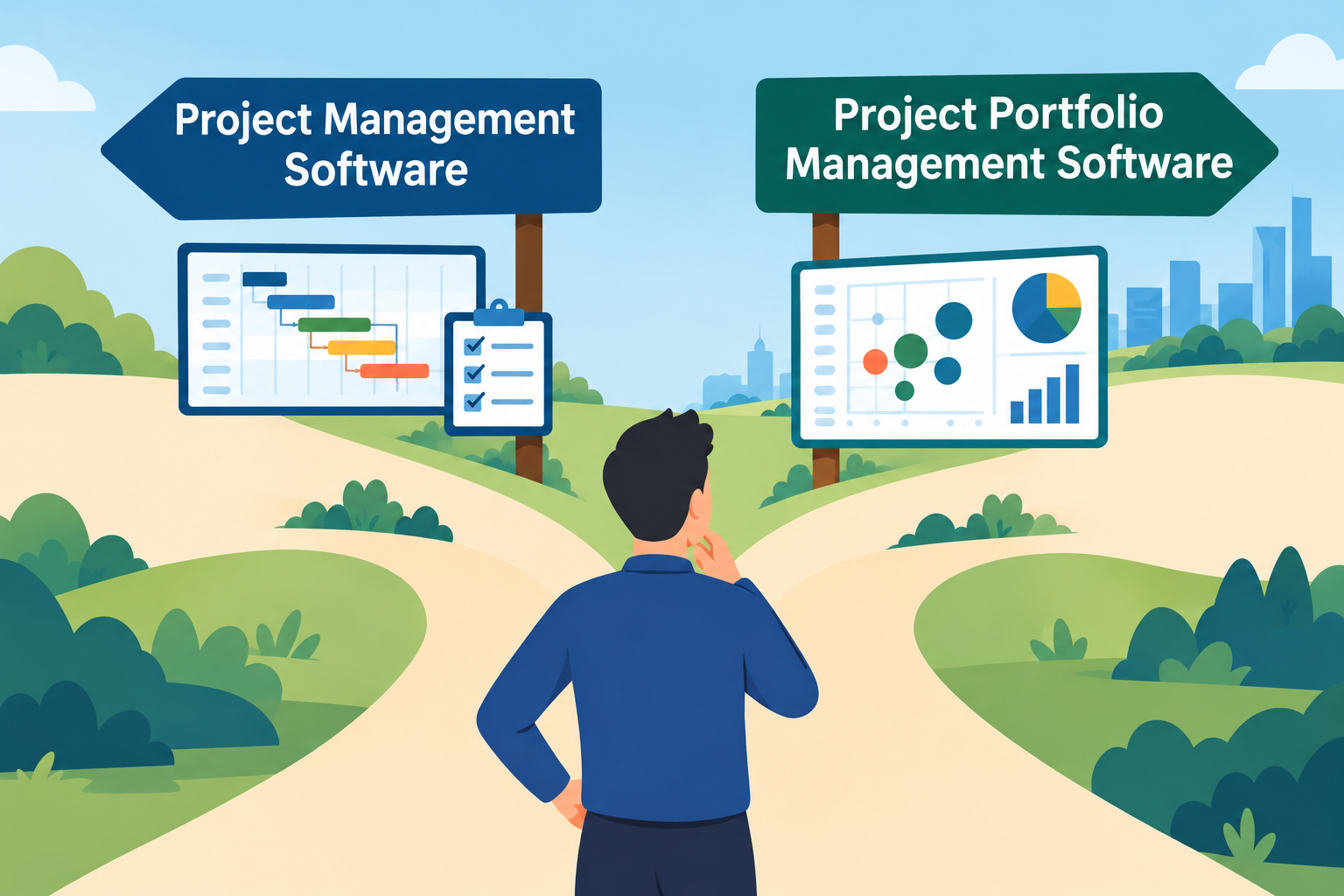
Project Management Software vs PPM Software
Why the benefit of the portfolio view costs less than you might think
Introduction
When your leadership team asks the simple question: “Which of our projects are we on track to deliver this year?” it’s often the case that nobody can answer quickly!
The data exists, because every project manager has updated their plan, logged their risks and reported their status. But that data might live in dozens, hundreds, or even thousands of separate plans, spreadsheets, and slide decks. There are also trade offs to consider. So, the PMO spends the next two days chasing, copying, reconciling and reporting. By the time the answer arrives, it’s already out of date – because projects have moved on.
If that sounds familiar, you’re probably weighing up whether your current project management practices are fit for purpose or whether it’s time to consider a software-based approach.
Assuming you’re already considering the change, the next logical question is: Do I need a Project Management Software or a Project and Portfolio Management (PPM) software solution?
In this guide, we’ll explain each software type, the key differences and where each tends to fit ‘best’.
Project Management or PPM?
Because each organization has varying needs and unique context, it’s important to first identify where on the journey you honestly are. To do that, consider your answers to these two questions:
“How much is there, really, that we want to manage?”
If your organization is running only a handful of projects, with just a few people involved, or your projects share virtually nothing in common in terms of delivery approach – you’re probably better off immediately considering a straightforward Project Management solution.
Why? Because there’s not enough data to roll-up, your stakeholders are likely all well-connected to the detail, and you won’t be comparing like-for-like when it comes to tracking portfolio level KPIs.
“Are we struggling to manage our projects with current resources?”
Resources in this context are not just people, it’s existing tools, practices, workflows or communications between the organization and its suppliers and partners.
PPM software is usually going to be a valuable investment if your managing projects at scale, your projects have a high degree of complexity – perhaps relying on geographically distributed teams for delivery – or you’re connecting project delivery to higher-level strategic objectives.
The short answer
The actual answer is a bit more nuanced…
To put the above statements into some context, it’s sometimes easier to think of the job-to-be done and the outcomes that might keep your stakeholder groups awake at night.
With this in mind, let’s look at which each of the two does well:
What does project management software do particularly well?
Let’s be clear, project management software has real value. Tools built for planning and scheduling are excellent at managing the detail of a single, or relatively few, project(s). They give an expert planner the flexibility to reshape a plan quickly as circumstances change.
They’re at their best when:
The project emphasis is on plan flexibility rather than repeatable process
The project plan is controlled by a small number of experienced users
The project goal is largely self-contained
The project success doesn’t materially affect a wider program or portfolio
For a specialist team delivering a one-off initiative, or projects that have little to no upfront structure, that can be exactly the right fit.
What PPM software adds
PPM software isn’t an alternative to project management. It’s a layer on top of it. A good PPM platform includes the project delivery tools that teams need and then adds two (or more) layers of aggregated data on top.

Layer 1 | Project Management: Delivers streamlined project execution
For example, Gantt scheduling, task management, risk and issue tracking, document management and collaboration features. In short, everything needed to run projects day to day.
Typical users:Project managers, Team members, Cross-functional partners
Layer 2 | The quality-assurance and process governance layer
PPM software brings the benefit of quality assurance and governance workflows that keep delivery aligned to organizational goals, through built-in templates, defined stages and gates for each project type and continuous improvement tools.
Typical users: The PMO and Process owners
Layer 3 | Optimized portfolio management
Strategic dashboards, Idea intake, prioritization and scoring, capacity planning, reporting and financial management.
Typical users: Executives, Senior leaders and Portfolio managers
The crucial point is that all three layers share one set of data. Most project management solutions either fail to consider co-dependencies between projects, fail to connect tactical delivery to strategy, or fail to enforce any form of process consistency.
The hidden costs of doing your project management in isolation
When an organization scales beyond projects managed in isolation or using standalone tools, a quiet cost builds up. Some call this the reporting tax, others: the opportunity cost. However you define it, the problem is the same:
Issue 1: Plans drift apart
Plans get copied from one project to the next, but gradually diverge from the best way of working, so delivery becomes less predictable.
Issue 2: Metrics don’t line up
Every project reports slightly differently, so comparing performance across projects becomes a manual exercise. Inconsistent data becomes commonplace.
Issue 3: Aggregation is manual
Someone, usually the PMO, is responsible for extracting and reconciling data before leaders can see anything.
Issue 4: Plan maintenance becomes a burden
Plans start to expand uncontrollably, forcing teams to follow progress rather than drive it.

Issue 5: Expertise becomes a bottleneck
Complex planning tools need skilled users, but most people delivering project work aren’t project management specialists.

Issue 6: Governance lives elsewhere
For example, in email chains, spreadsheets, and meeting minutes.
If that doesn’t convince you, Wellingtone, a UK based technology, consulting, and training firm concluded, in their 2025 “State of Project Management” report, that half of organizations delivering projects still lack real-time KPIs, and that 42% of practitioners spend a day or more each month manually collating project reports. In 2026, that’s a shocking statistic.

If you’re still collating project reports manually, your hidden reporting costs far outweigh any investments required for a PPM software solution that automatically collates and aggregates data for you.
Why your portfolio data comes “for free”
This is the part that often gets overlooked in vendor research. If you’re deciding between Project Management Software vs PPM Software or, building a business case for PPM software – and finding it hard to convince senior management of the ‘extra value’ – think about:
The work you’re already doing
Project managers already enter tasks, dates, owners, risks, budgets and status updates. That effort happens whether you use a project management tool or a PPM platform. It’s a cost you’re already paying.
Extracting and linking data to identify trends
In standalone project management tools, all your rich data stays locked inside individual plans/risk registers etc. To turn data into portfolio insight, someone has to dig it out, standardize it and rebuild it in a spreadsheet, report, or slide deck. The same happens, again and again, as each new reporting cycle looms.
Enter data once, see it everywhere
In a PPM platform, projects are most often built from templates that start with consistent stages, gates, milestones, and metrics. Even if the plan evolves, the core structure can be enforced and changes tracked. Where desired, team updates flow automatically into program and/or portfolio views. The executive dashboards that feed decisions doesn’t become a separate piece of work, it’s a by-product of the work already being done at the project level.
As you can see, the same project data can take two very different paths depending on which route you choose.
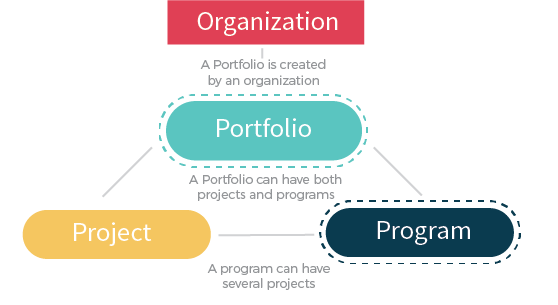
Dotted lines: Project and Portfolio Management provides an in-the-round view of individual projects, their connections to others and their relative importance to the organization as a whole. Connecting strategy and implementation.
The “extra 16%”
Yes, PPM asks for a little more up front: agreeing on a starting structure for your project type templates, defining scoring criteria for prioritization decisions and setting up governance workflows. But that effort is largely one-off, and the return keeps paying out week after week. You’re not only capturing value from delivery data, but you’re also given the tools to transform it into something much more meaningful.
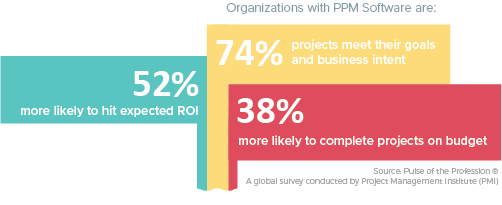
Consistency matters more than it might seem, and the evidence supports this. The well-respected Project Management Institute (PMI) regularly cites research that organizations using standardized practices across their business, report that 74% of projects meet their goals and business intent, versus 58% for organizations without them. That sixteen percent ads real value to the bottom line (and pays for your PPM software investment, by some considerable margin).
Adoption becomes your multiplier
The “free” data only flows if people actually use the system. That’s why ease of use for frontline users matters. When project teams find the tool helpful rather than burdensome, they’ll invest time to keep it up to date. Better data then flows upward, and leaders get insights they can genuinely trust.
How do I answer the big questions of Project Management vs PPM?
If you’ve gotten this far and haven’t yet found a way to defend PPM software being perceived as more expensive and complex than project management solutions, the honest answer is it depends on how you define cost (vs value) and the vendor/platform benefits.
It’s true to say that some PPM systems do involve longer implementations, a degree of consulting support and – in some cases – steep product learning curves. But that’s no longer the norm. The category has moved on and modern, configurable, SaaS platforms have dramatically sped up deployments, reduced training burdens, and improved connectivity to the wider business ecosystem. So, here’s our 5-point checklist to consider when comparing costs:
Look beyond the setup and license fees and consider the broader value
Most vendors aren’t out to extract maximum fees. They all operate in open markets and they need to stay competitive. If they’re opaque on where the fees might (later) come, treat that as a warning sign or at least as a place to dig further early on.
Consider what the reporting tax might be costing you
If you have no software solution in place, start by adding up the hours spent compiling, reconciling, and presenting, project status data. If you’re weighing up a Project Management point solution vs a PPM platform, your hidden costs will be manifest themselves in connecting your data points.
Consider time-to-value
There are a lot of self-configured options out there – and modern usability design provides users almost endless scope to imagine the system of their dreams. That can be great, but it may tie you to aligning to organizational demands for far longer than you anticipate. It can also consume a lot of time of internal resources to learn the platform and how to get the most out of it. Vendor supported, or managed, deployments can free up time to continue your day job, deliver best-practice insights from other customers/sectors and deliver tangible results quickly.
Think about how people will use it
Are you looking for a platform designed for specialists or non-specialists? Both are valid routes, but each varies considerably when it comes to sharing data with a broader audience from across the organization.
Identify what’s included as standard
Transparent, inclusive pricing avoids surprise costs, yet you’ll often find vendors charge extra for each new project, the amount of data consumed, non-standard – but important – modules, integrations, or support. Extra fees can be entirely justifiable – especially in enterprise deployments that involve hundreds, or potentially thousands, of users collaborating in real-time, but they should be transparent.
For most organizations, the extra investment required to capture the benefits of a portfolio level tool over a project management tool is modest. But the gap in value is usually significant.
When project management software alone is enough
In reality, not every organization needs PPM yet. As stated prior, if you run a few unrelated projects and each is controlled by an experienced planner, have no need to compare, prioritize, or report across your projects, then a good project management tool may serve you well.
When your organization evolves to a point where there’s a need to scale or to make more efficient use of resources across a growing number of projects, a more comprehensive approach to PPM will likely become a necessity.
Conclusion
Project management software helps you run projects well. PPM software does the same and then turns the data your teams are already creating into the program and portfolio-wide insights leaders need to invest wisely. The extra effort and cost is small, but the view it gives you is something that standalone tools just can’t provide.
Frequently asked questions
No single article can provide all of the answers and noting the multi-stakeholder, multi-buy-in and multi-faceted nature of the PPM Software vs. Project Management Software question, the following Q&A’s may help readers in their decision process:
Project and Portfolio Management software from Bubble
Turbocharge productivity in your organization
About Bubble
Bubble® is a leading software company specialized in the development of Enterprise Project Management and Project Portfolio Management (PPM) solutions. Our cloud-based PPM software, Bubble PPM, helps organizations in Innovation, R&D, New Product Development, and other disciplines, to select the right projects, execute them reliably, and improve productivity.
Founded in 1999, the company is Headquartered in the UK, serving customers across the globe via our offices in Cambridge, London, and Melbourne.
About Bubble
Bubble® is a leading provider of Project and Portfolio Management software. Founded in 1999, the company serves clients globally via offices in London, Cambridge, and Melbourne.
Its cloud-based solutions help customers improve the planning, governance, and delivery of Innovation, New Product Development, Engineering, IT, and other initiatives.